
Our Lawyers Provide First-class Advice on Statutory Demands and Winding Up Petitions
We are leading experts specialising in insolvency proceedings. Our chancery barristers and solicitors have decades of experience in Insolvency and Winding-up Petition law and have advised on many hundreds of cases. Our leading insolvency barrister has succeeded in numerous cases including before the Court of Appeal. Our lawyers regularly appear on and manage Winding-up Petition cases. Both our solicitor and our barrister will be available to you at the outset in your first advice conference; when accurate legal advice matters the most in ensuring a sure-footed legal strategy going forwards.
Our experienced City of London solicitors and barristers regularly assist companies facing a HMRCwinding up petition; individuals served a statutory demand; or creditors owed money and considering issuing a winding up petition.
Company
Monthly Insolvencies (April 2026)
Compulsory
Petition Orders (Estimated for 2026)
Petition cost
Winding-up Court fee + £2600 Deposit
Min. Debt
Debt Required to Present Petition
(Source: The Insolvency Service and the Ministry of Justice Statistics)
Your search for a solicitor in relation to debt recovery or to avoid a winding up order ends here. Our solicitor and barrister team can guide you through the minefield of complex winding-up rules and procedure and help you manage the entire process. We have years of experience in negotiating with debtor companies and their solicitors as well as creditor, shareholder or director petitioners (in particular HMRC).
We regularly represent our client companies in the High Court/Companies Court and successfully obtain adjournments (i.e. to allow time to negotiate and settle or to defend a winding up petition). We also help companies to avoid having bank accounts frozen by preventing the advertisement of winding up petition notices or (if already advertised in the London Gazette) by obtaining a validation order from the Court to unfreeze the company’s bank accounts. We have a proven track record of delivering legal advice and legal solutions. We know exactly how to get the best results for your business.
LEGAL CASE ASSESSMENT
Just fill out our simple enquiry form; it goes immediately to our litigation team in Middle Temple, London. You can also call our lawyers on +442071830529 from 9am-6pm.
Our ⭐⭐⭐⭐⭐ Client feedback:
Fought To Keep A Company Alive
“Extremely deep understanding of the law surrounding their specialist areas. We were on the back foot and fighting to keep a company alive, I was truly staggered by what they achieved in the few days they had, they exceeded all expectations and achieved our goal for us… I can highly recommend this firm.”

I simply would not go anywhere else
“GREAT OUTCOME! – LEXLAW is an excellent firm of solicitors. I have used them on several occasions and I am very impressed with their knowledge of the court system and case law. I simply would not go anywhere else if ever I needed representation for any of my companies.”
Successful Dismissal Of HMRC Petition
“Lexlaw were appointed 1 week before the date of a HMRC winding up petition and successfully represented the company at court to win the case.
I am happy with the result and I was fortunate enough to appoint LexLaw to act on my behalf. I would definitely recommend LexLaw!”Helped My Company Survive
“LEXLAW helped my company through a very difficult time and supported us with all the legalities that were necessary to help my company to survive. This is a legal company who listens to their client and answers in appropriate terms which are not presented in legal jargon but in terms the client understands.”
Emergency Disputed Debt Defence
“Would recommend!
Successfully defended an unlawful statutory demand on my behalf and all done within 10 days …
Great job!”Debt & Legal Costs Recovered in Full
“LEXLAW successfully handled our debt recovery case.
I would not hesitate in recommending them to anyone who is having problems recovering debt.”Wound-up Debtor Security Company
“Lexlaw never give up on cases no matter how tough it may seem. Very resilient in attitude and conduct. They are happy when their clients are happy for all their achievement. I highly recommend them.Petition Defended & Dismissed
“Extremely helpful and professional.
They explained the process and executed a fantastic result for us.
Highly recommended.”Winding Up Petition Got Bill Paid
Successfully defended our company against a large international client. Case was settled over and above what we expected in a very short time frame. We were kept informed at every stage which ran very smoothly. I have no hesitation in recommending Lex Law to anyone. Thanks Again!!







Dual-Qualified UK Debt Lawyers
Our dual-qualified Solicitor & Barrister team assess your case at the outset and do everything professionally and by the book avoiding problems for you later on. We will quickly determine the merits and prospects of the claim and then also advise you on how to obtain an optimal outcome.

LEADING CITY LAWYERS
Qualified solicitors & barristers with leading insolvency & litigation expertise operating from Middle Temple Chambers.

INSOLVENCY SPECIALISTS
Experienced in setting aside statutory demands, advising on petitions, adjournments, validation orders & debt recovery

SRA REGULATED
Unlike most debt collection agencies or unregulated claims companies, we offer legal advice regulated by the SRA and BSB
WARNING ABOUT DEBT RECOVERY AGENCIES
Debt recovery agencies are not authorised solicitors and so are not lawfully entitled to manage a winding-up petition or any court litigation in the UK (a criminal offence under the Solicitors Act 1974). They may engage in sharp practice against you and the other side which may cost you more in the long run. You could also be punished by the Court. Petitions should only be managed by legal professionals reporting directly to you.
Our Areas of Legal Expertise
We regularly undertake insolvency litigation in these core areas:
DEBT RECOVERY
Securing payment of unpaid debts for creditors, lenders & local authorities: pre-action collection; Court proceedings; judgment debt enforcement; statutory demands; winding up proceedings
VALIDATION ORDERS
Specialist Validation Order Solicitors in issuing s127 validation order applications for companies; representation at validation order hearings; dealing with creditors such as HMRC
STATUTORY DEMANDS
Set aside/challenge/issue statutory demands; experienced legal negotiators dealing with debtors/lenders/creditors
WINDING-UP PETITIONS
Challenging/set aside winding up petitions; pre-action representation; advocacy at Court hearings; malicious presentation of winding up petitions claims; injunctions retraining petition presentation/advertisement
Need advice from Specialist Insolvency Lawyers?
We can help to bring or defend a Winding-up Petition, obtain an Adjournment or Time to pay, deal with a Statutory Demand, apply for a Validation order or an injunction to stop a petition advertisement.
We are a specialist leading City of London law firm based in the Middle Temple Inns of Court adjacent to the Royal Courts of Justice, High Court and Companies Court.
We have the strongest possible record of success in dealing with numerous bankruptcy or winding up petitions and are regularly recommended to clients by leading accountants and leading insolvency professionals.
We advise company directors on the best course of legal and commercial action for the business (for example restraining advertisements, obtaining validation orders to unfreeze bank accounts, obtaining winding up petition adjournments and time to pay HMRC, defending winding up petitions).
We add value by recommending insolvency routes, where appropriate, such as Voluntary Arrangements (CVAs, PVAs, IVAs), Administration or other insolvency routes).
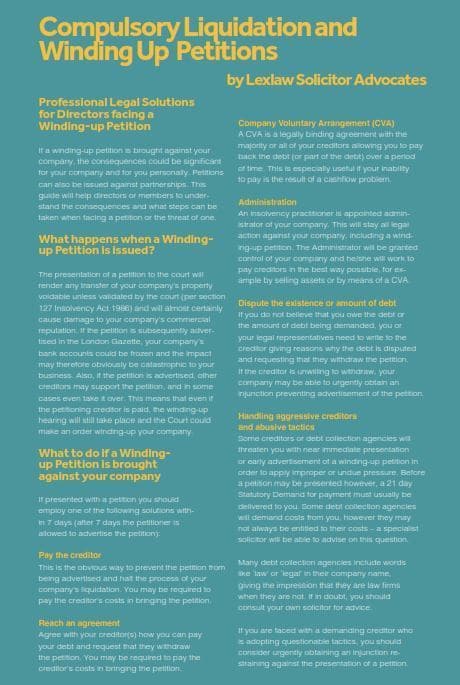
Download our guide to Compulsory Liquidation & Winding Up Petitions
The Company Director’s Guide on Insolvency
Our Insolvency team regularly provide market leading advice to directors of companies and limited liability partnerships. Our work has featured in KSA Group‘s Worried Directors Guide, including our authoritative guide on compulsory liquidation and winding up petitions.
Winding Up & Insolvency FAQs
Frequently Asked Insolvency, Petition and Stat Demand Questions
Can I set aside a statutory demand?
Yes, but it is imperative that you act promptly – you have in the first instance only 18 days as of right to apply to the Court for a set aside once you have received a Statutory Demand. Often the use of Statutory Demands is inappropriate and in some cases they can be set aside by the Court.
What does a winding up petition mean?
A legal class-action petition to the court via which a creditor owed over £750 can force an insolvent company into a compulsory liquidation in the interests of all creditors. The court will have a petition hearing to determine if the company is insolvent and if it determines so, will then order a winding-up. The Official Receiver or an Insolvency Practitioner will subsequently investigate and liquidate the insolvent company realising and distributing assets to the body of creditors including overdrawn directors loan accounts.
The process and purpose of winding up can be summarised as a process “to make equable and rateable distribution of all assets of a company … amongst all creditors of the company without favour or preference” (Ince Hall Rolling Mills Company Ltd v Douglas Forge Company).
On what grounds can a company challenge a winding up petition?
- The debt alleged in the demand to be owing is genuinely disputed on substantial grounds by the company.
- The company has a genuine right of set-off against the creditor which exceeds the amount claimed in the demand.
- In certain other limited circumstances (for example such as jurisdiction; company likely to become insolvent; technical or procedural error or delay).
Can I seek an adjournment of a winding up petition?
Yes. The first port of call would be to write to the petitioning creditor (in most cases HMRC) asking for an adjournment- the request would be more persuasive coming from a solicitor (we have liaised with HMRC many times).
If the petitioning creditor refuses then you need to ask the Court at the hearing for an adjournment. We have the necessary experience and legal knowledge of the circumstances in which the Court exercises discretion and can help to get your business an often much needed adjournment.
What is a malicious winding up petition?
A malicious winding-up petition is one that has been presented against a company for an improper or wrongful motive. A company that suffers a malicious petition can bring a Court claim for malicious prosecution against the petitioner.
I am a creditor. How do I recover an unpaid debt?
We are lawyers that specialise in recovering unpaid debts from individuals or companies so we know the best way to get your unpaid debts paid up quickly. This may involve Insolvency or Litigation proceedings.
To date, we have a 100% success rate and all of the petitions we have issued have been resolved in our client’s favour. This has also meant that the petitioned company or individual has paid our fees. Luckily for our clients this means instructing us to pursue their bad debts has ultimately recovered the sums owed plus interest with a refund of their legal costs.
What is a validation order?
Validation Orders are orders authorising the disposition of property made after the presentation of a winding-up or bankruptcy petition which would otherwise be void in the event of a winding-up or bankruptcy order being made.
A validation order will allow a company to continue to trade or perhaps dispose of a specific asset such as a property on the basis it has been determined these transactions are to the benefit of all creditors.
What are the consequences if a winding up order is made?
If a winding up order is made by the court, this will ordinarily signal the beginning of the end for the company. The following consequences occur automatically on the making of a winding up order against a company:
- The Official Receiver becomes the liquidator of the company (section 136, 1986 Act).
- The powers of the company’s directors cease (Measures Brothers Ltd v Measures [1910] 2 Ch 248).
- The liquidator takes control of the company’s assets (section 144(1), 1986 Act).
- Any disposition of the company’s property by anyone other than the liquidator is void (section 127(1), 1986 Act).
- All company papers must state that the company is in liquidation (section 188(1), 1986 Act).
- The winding up order operates as notice terminating the employment contracts of all the company’s employees, who are thereby automatically dismissed (Re Oriental Bank Corporation, MacDowall’s Case (1886) 23 Ch D 366).
- There is a stay on the commencement or continuation of proceedings against the company except with the permission of the court (section 130(2), 1986 Act).
Insolvency and Winding-up News
UK Insolvency Legal News Articles from our team:
Time-barred debts: can a creditor still petition on an old debt?
Yes, a creditor can still serve a statutory demand on an old debt. Section 123(1)(a) of the Insolvency Act 1986 asks whether the company is “indebted in a sum exceeding £750 then due”, and nothing in that wording asks whether the creditor could still sue for the money. The difficulty comes afterwards: if the debt…

Can You Reuse Your Company Name After Liquidation? Phoenix Rules, Personal Liability and the 2026 Crackdown.
Yes, you can reuse your old company’s name after it goes into insolvent liquidation, but only if you fall within one of the three exceptions in Part 22 of the Insolvency (England and Wales) Rules 2016 or the court gives you permission. Otherwise section 216 of the Insolvency Act 1986 bars anyone who was a…

Can a Foreign Judgment Wind Up Your UK Company?
Your company owes money under a judgment obtained abroad and a demand has now landed at the registered office. Many directors assume an overseas creditor must sue again in England before it can touch the company here. Since July 2026 that is wrong. In Drelle v Servis-Terminal LLC [2026] UKSC 29 the Supreme Court held…

A Winding-Up Petition Has Been Presented: Can You Still Get A Moratorium or Go Into Administration?
Yes, a company facing a winding-up petition can still enter administration or obtain a Part A1 moratorium, but only through the court. Once a creditor has presented a petition, paragraph 25(a) of Schedule B1 to the Insolvency Act 1986 stops the company and its directors appointing an administrator out of court, and section A3(1)(a) closes…
Want legal advice on the merits of your case?
Our simple enquiry form goes immediately to our litigation team in Middle Temple, London. Call us on +442071830529 from 9am-6pm.